
Fayette County Criminal Court Cases
The Fourth Judicial Circuit includes Fayette County Circuit Court, the county trial court for felony, misdemeanor, DUI, traffic, and ordinance prosecutions. Illinois does not place these local files in one free statewide trial-court document system. Instead, the Fayette County Circuit Clerk preserves the official court record. The filed case, rather than the initial booking charge, shows what the prosecutor chose to pursue.
Fayette County criminal court cases share one courthouse system. Municipal matters ordinarily enter Circuit Court instead of a separate city court of record. That makes the court and case number crucial. A name match alone can point to the wrong person, while the case number ties events, counts, payments, and orders to one file.
Fayette County Cases on Judici
Fayette County directs the public to Judici, a vendor-hosted service used by participating Illinois counties. Basic case information is available without treating Judici as the official paper file. Document images may be absent or placed behind an account or paid function. Search results are best used as an index that identifies the court, case number, status, and relevant docket dates.
The Judici interface gives Fayette County readers a practical first look at a criminal court case before they contact the clerk. The source page below shows how the county case-search service is presented.
View the official county-participant case search source.
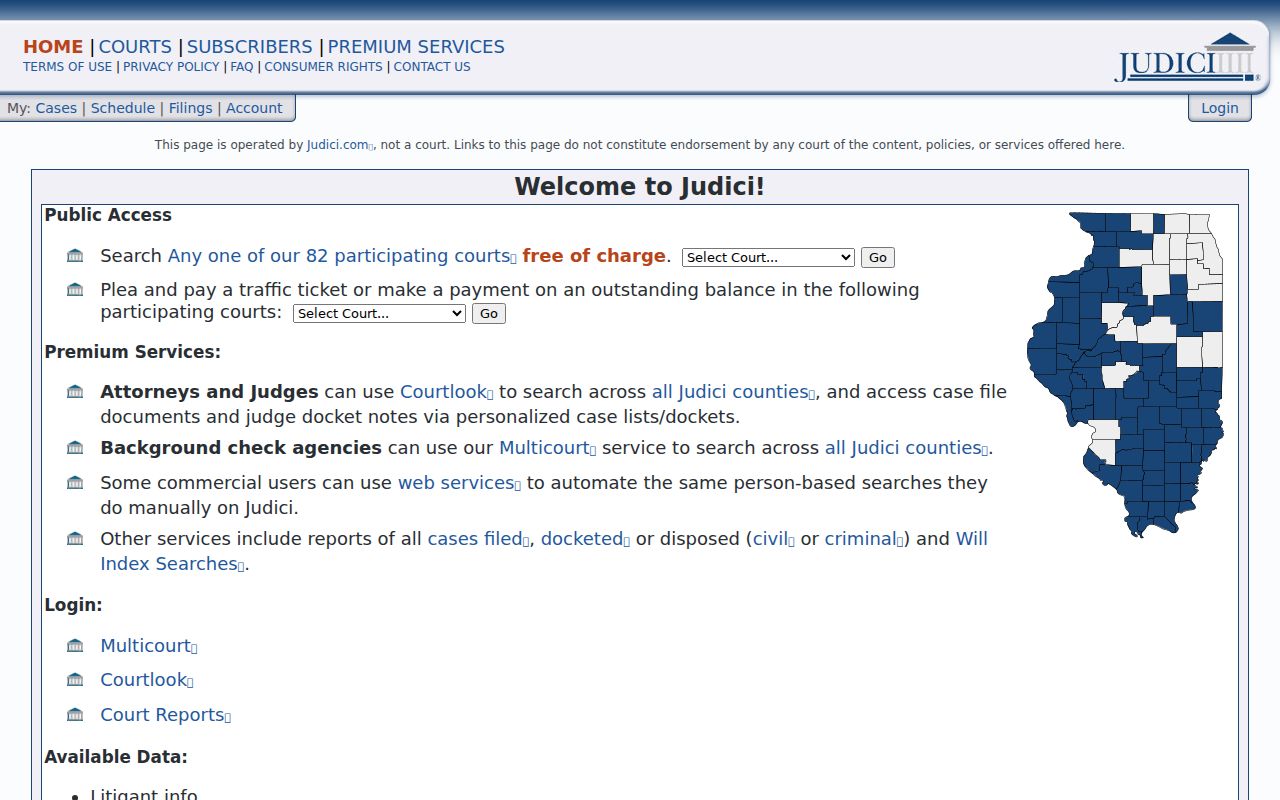
This search view helps locate the docket summary, but the Circuit Clerk remains the custodian of Fayette County court records.
Searching Fayette County Case Records
Start broadly enough to find likely matches, then use the case identifiers to narrow the result. A current Fayette County criminal case may appear beside traffic or ordinance matters, so read the case type and each count rather than relying on the caption.
- Open Judici and select Fayette County from the participating courts.
- Search by a party name or enter the exact case number when known.
- Compare the filing year, case type, status, and party role.
- Open the docket and read each charge, event, disposition, and next setting.
- Request a plain or certified copy from the Circuit Clerk when proof or a full document is needed.
The public controls documented for the service support either a name search or direct case-number lookup.
| Field label | Type | Required | Use |
|---|---|---|---|
| Last name | Text | No | Pairs with first name for party search |
| First name | Text | No | Helps narrow common surnames |
| Case number | Text | No | Direct route when the full number is known |
| Court | Select | Yes for county search | Choose Fayette County |
| Case type or year | Filter | No | Separates likely criminal results |
Fayette Court Files in Room 112
The Fayette County Circuit Clerk serves the full public file from Room 112 at 221 S. 7th St., Vandalia, Illinois 62471. The counter is open weekdays from 8 a.m. to 4 p.m. Call 618-283-5009 to ask about archived material, a file that is missing online, or whether a requested copy can be sent. A public-access computer is also available at the office.
Fayette County Circuit Clerk
221 S. 7th St., Room 112
Vandalia, IL 62471
618-283-5009
Monday-Friday, 8 a.m.-4 p.m.
The clerk's official page also explains court access and fees. The image below preserves that Fayette County source context.
Review the Circuit Clerk records and fee page.
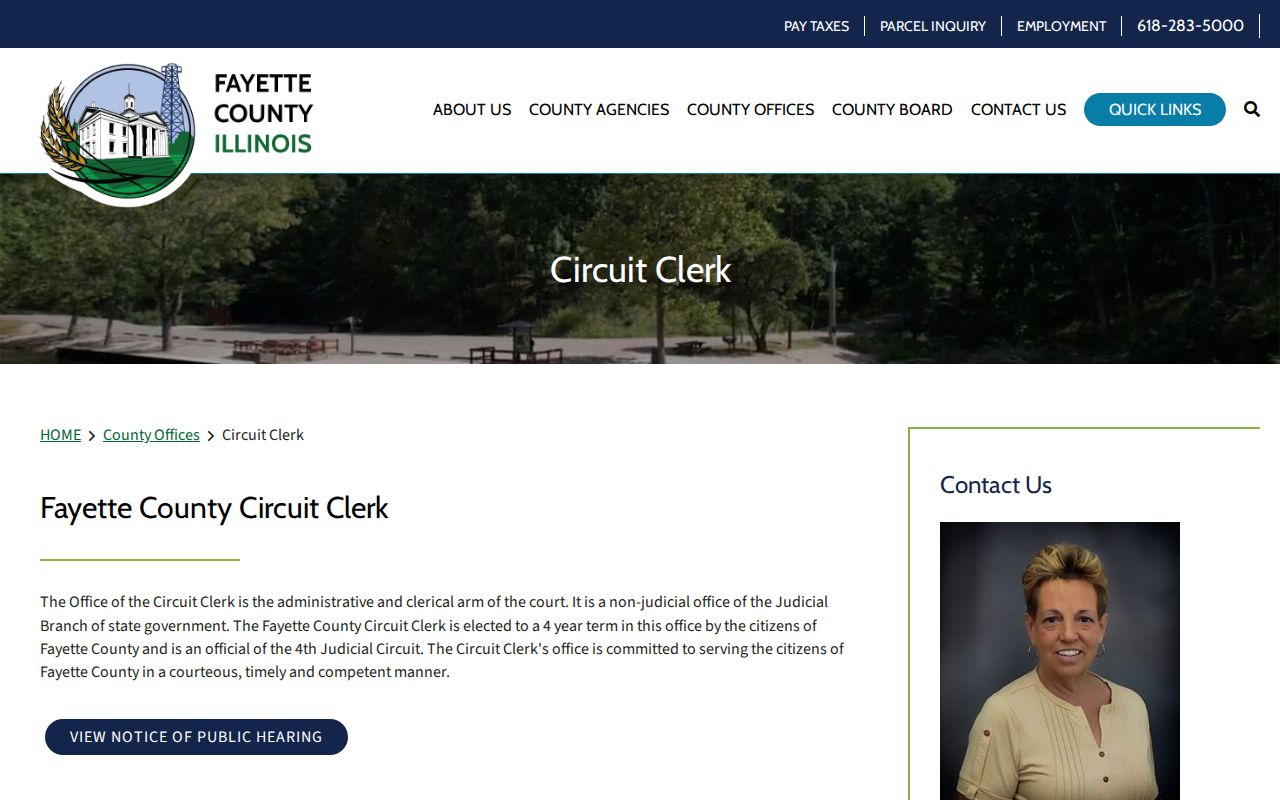
The county page is the right place to confirm hours and copy procedures before a visit.
Copy fees rise by page band: $1 for the first page, 50 cents for each of the next 19 pages, and 25 cents for each later page. Emailed information can cost more because deputy-clerk research is involved, though the county does not publish that amount. Ask for an estimate before ordering a long Fayette County criminal case file.
Note: County pages show both 211 and 221 South Seventh Street, while office-specific justice pages use 221; confirm the room and entrance before travel.
Inside a Fayette County Case File
A Fayette County court summary centers on charges as filed and the court's acts. It is not the same as an Illinois State Police transcript, which groups fingerprint-linked arrest cycles and reported dispositions. The court file is the better source for a motion, amended charge, plea, judgment, or sentence in a specific prosecution.
| Case number and court | Identifies the Fayette County file, filing year, and Circuit Court. |
|---|---|
| Charging document | Shows the complaint, information, or indictment and the counts filed. |
| Docket entries | Lists appearances, counsel, pleas, continuances, motions, orders, and hearings. |
| Hearing dates | Shows scheduled date, time, and hearing text when publicly posted. |
| Disposition and judgment | Records the outcome for each count, including dismissal, acquittal, supervision, or conviction. |
| Sentence and conditions | May show custody, probation, financial assessments, and other public orders. |
Financial fields can include assessments, fines, costs, payments, and a balance. A summary does not guarantee access to the underlying pleading. Protected identifiers, victim data, and restricted documents do not belong in the ordinary public view.
Read Fayette County Count Outcomes
One Fayette County criminal court case can contain several counts, and those counts need not end the same way. A filed charge may be amended, dismissed, resolved by supervision, tried, or included in a plea. The caption does not tell that full story. Match each sequence number with its statute, offense class, and disposition.
- Disposition
- The recorded outcome of a charge or case.
- Nolle prosequi
- The prosecutor's formal choice not to continue a charge at that time.
- Supervision
- An Illinois result that can avoid a conviction judgment if completed under the governing law.
- Acquittal
- A not-guilty result after adjudication.
- Docket
- The chronological register of filings and court events.
A missing disposition does not prove that a Fayette County case remains open. It may reflect a reporting or linkage gap. Get certified court proof from the clerk before challenging a mismatch on an ISP record.
How a Criminal Case Moves
A Fayette County prosecution can begin after arrest or by summons. When a person is detained, a prompt first appearance addresses custody and release. The State's Attorney then reviews the facts and selects the charges to file through a complaint, information, or indictment. Arraignment places the formal charge and plea on the docket.
Case flow: Charges Filed › Arraignment › Pretrial › Plea or Trial › Disposition › Sentencing
Discovery, motions, and continuances can add many entries before a plea or trial. Post-judgment action or an appeal may follow. Court text reminders and the county's no-password Criminal Court Zoom room, ID 290 921 2267, can help track a setting, but remote attendance does not grant access to sealed records.
Fayette County Prosecution and Defense
The Fayette County State's Attorney prosecutes felony, misdemeanor, DUI, traffic, and juvenile matters. The office reports an average yearly workload of about 200 felonies, 300 misdemeanors, more than 125 DUIs, and 5,000 traffic cases. That volume explains why a name search can return a large mix of case types even in a small county.
The prosecutor source pictured below gives local context for how filed charges enter Fayette County criminal court cases.
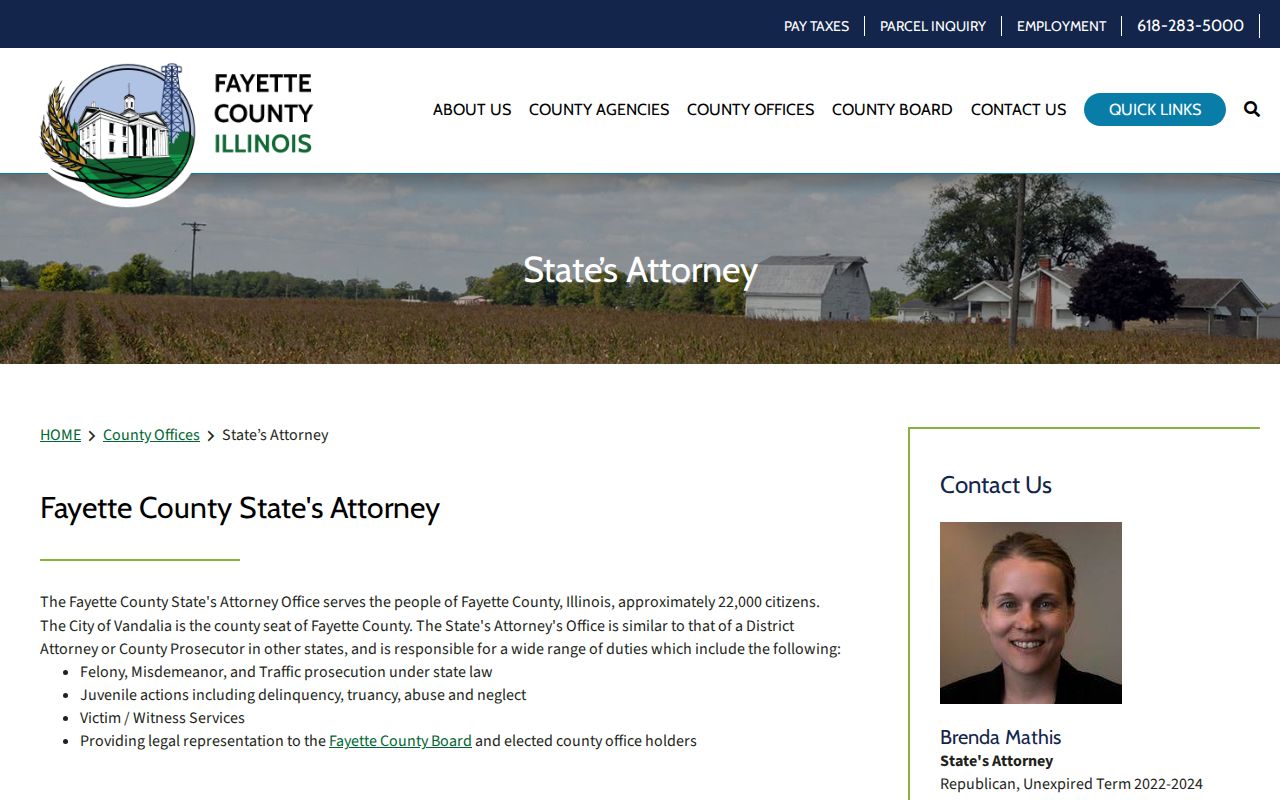
The office's role is to bring and manage charges for the State of Illinois, while the clerk keeps the neutral case file.
The Fayette County Public Defender represents eligible defendants only after Circuit Court appointment. Its Room 213 office handles consultations by appointment and warns that case volume makes talks just before or after court hard to arrange.
The public defender source below identifies the local appointed-defense channel.
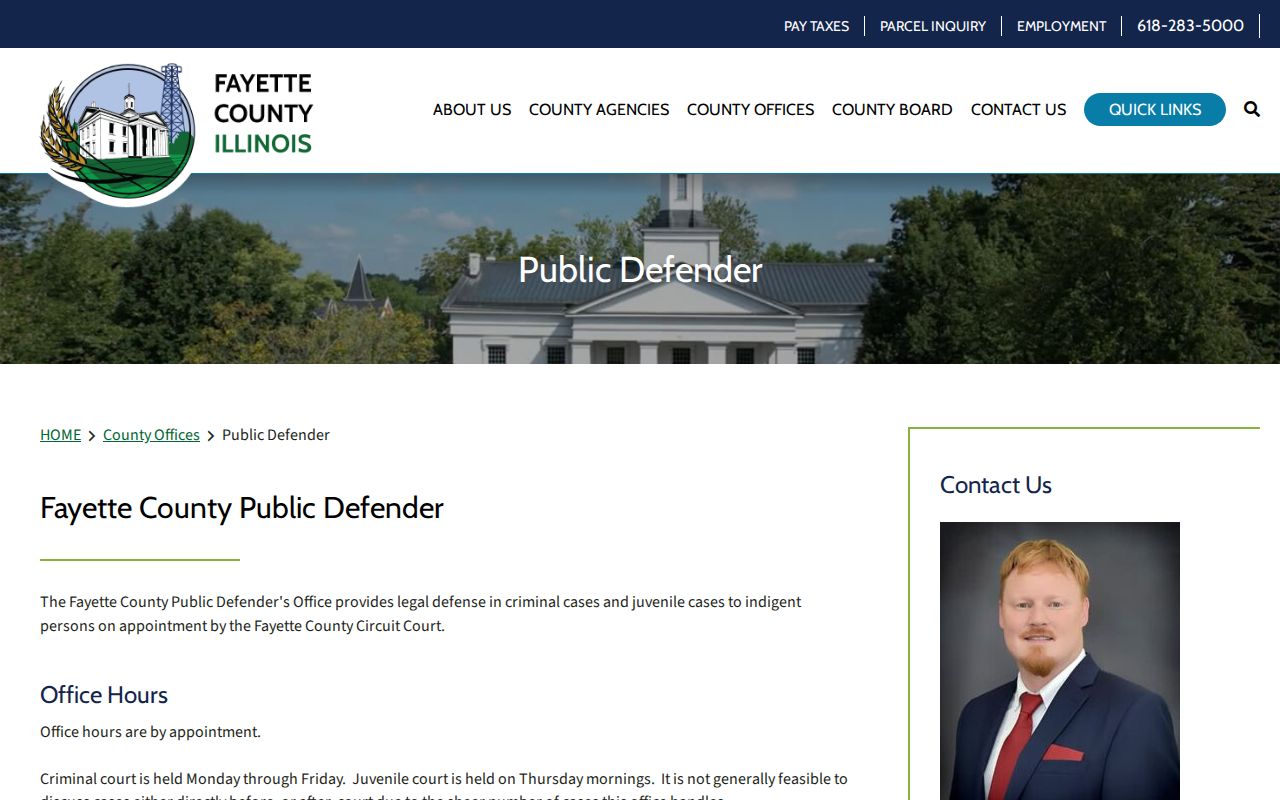
For a personal case, counsel can explain legal strategy; the public docket remains the source for posted events and orders.
Federal Cases Beyond Fayette Court
A federal prosecution tied to Fayette County does not appear as a Fayette County Circuit Court case. The U.S. District Court for the Southern District of Illinois covers the county. Federal electronic dockets and documents are accessed through PACER, which uses its own registration and fee rules.
The official federal portal shown below is separate from Judici and the county clerk.
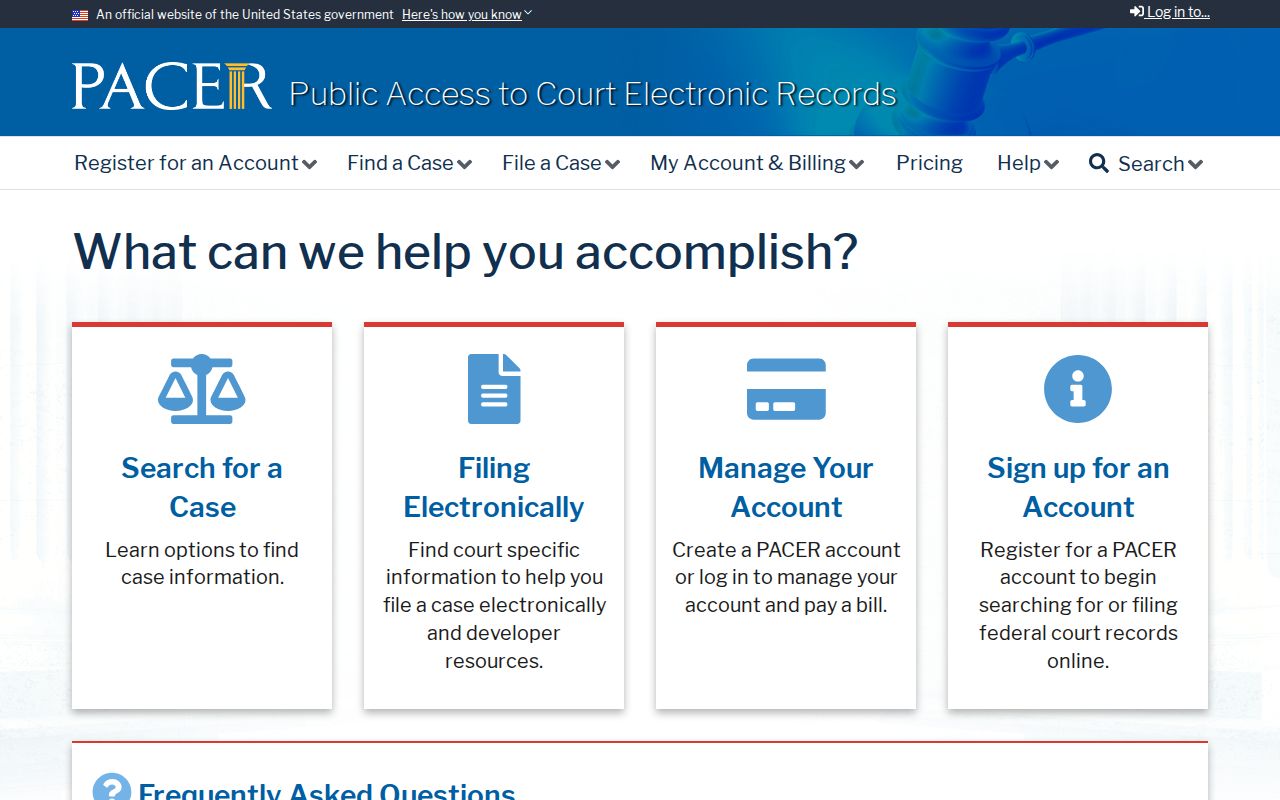
This distinction prevents a false conclusion that no case exists merely because the Fayette County index has no match.
Case Record Access and Restrictions
Most Fayette County court records are public, but juvenile, adoption, impounded, and sealed cases are excluded from ordinary access. The Illinois Supreme Court's security and privacy policy also limits identifiers and material covered by a court order. Public summaries omit or redact Social Security numbers, financial-account data, protected victim or minor information, and sensitive addresses.
The Illinois Freedom of Information Act does not override a sealing order or court confidentiality rule. Court-file access runs through the Circuit Clerk and judicial access policy, while a police report stays with its creating agency. If Judici shows nothing, ask the clerk about spelling, archived records, and access status. Do not assume that absence means no Fayette County criminal court case ever existed.
Access point: Ask the clerk whether a public portion can be inspected when part of a Fayette County case is restricted or redacted.