
Sex Offender Checks in Fayette County
The Illinois Sex Offender Registry is the main public channel for Fayette County. Illinois State Police maintains the database and states that it updates daily. A user must first read the disclaimer, then can search by identity or place. The county has no separate public offender map documented in its official pages, so the state registry supplies the public list and neighborhood map.
Local law enforcement still has a distinct role. Registration occurs with the agency responsible for the person's residence. County-area instructions come from the Fayette County Sheriff's Office, while a municipal police department may be the proper registering agency inside a city. If no listing appears, ISP tells users to contact local law enforcement for help rather than infer that no duty exists.
Fayette Registry Updates Need Context
A daily database update does not mean each Fayette County address is verified at the instant a person searches. A move, agency report, or status change can take time to pass through registration and publication steps. Read the displayed compliance status and registration agency along with the address. A yellow map marker only represents the public record at that point in time.
The ISP disclaimer describes those limits before public access. Its official presentation appears below.
Read the Illinois registry disclaimer source.
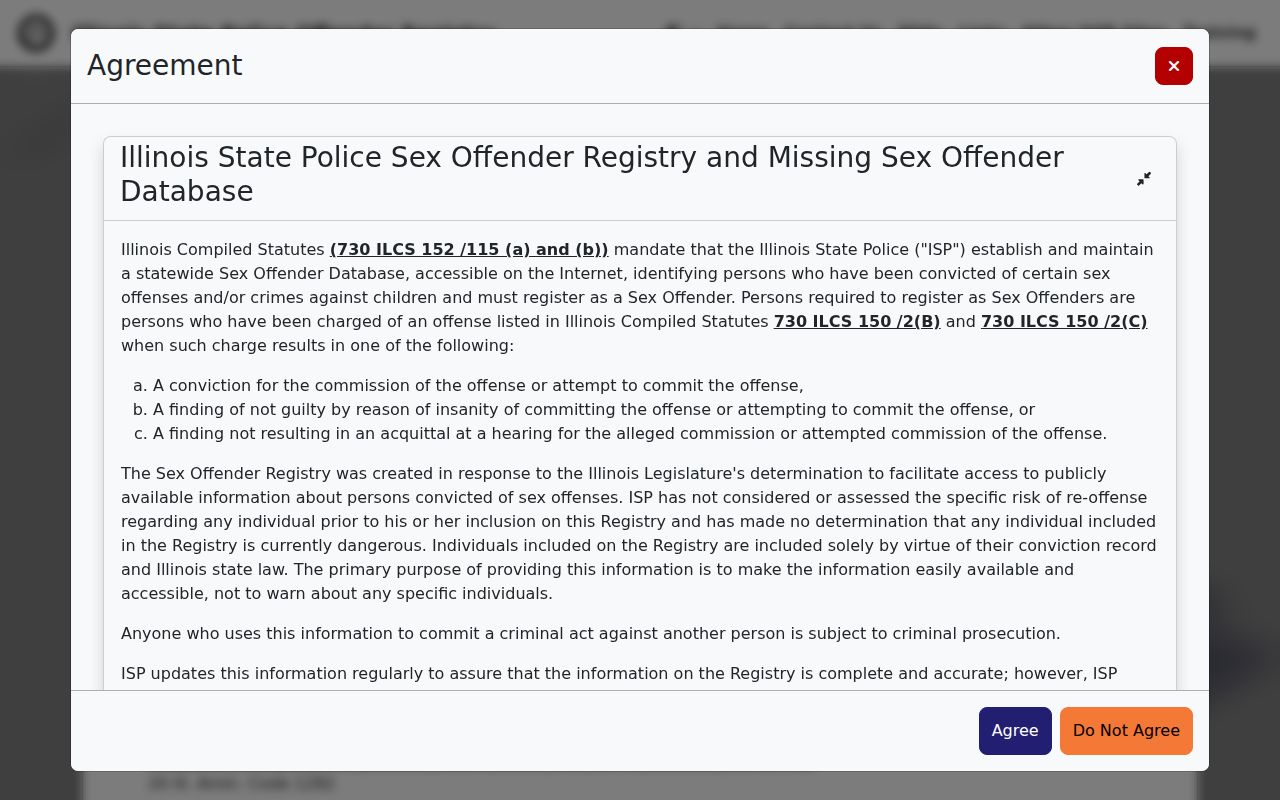
The access gate is a reminder to confirm material and use it only for lawful safety purposes.
How to Search the Illinois Sex Offender Registry
The state search supports a broad name query and more focused filters. ISP recommends starting with first and last name, then narrowing with other facts. A Fayette County filter helps with county-area results, while city and ZIP fields can focus on Vandalia, St. Elmo, Ramsey, or another Illinois community.
- Open the official registry and accept its conditions of use.
- Enter a first and last name, or choose location fields for Fayette County.
- Narrow a likely match with birth date, city, ZIP, status, or offender type.
- Open Details and compare the public identity, address, agency, offense, and registration fields.
The registry source pictured below shows the official search interface available after the disclaimer.
Open the Illinois offender registry search.
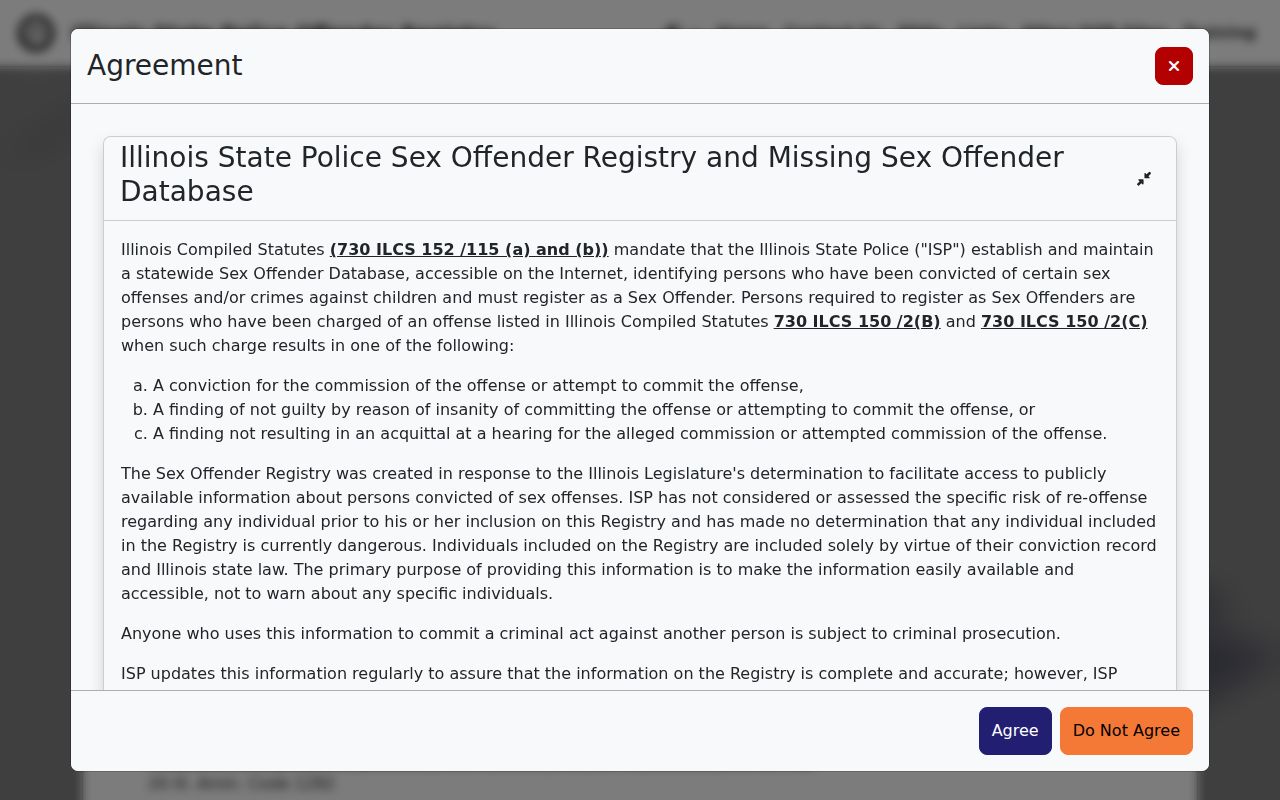
This interface is the proper starting point for a current public Fayette County registry lookup.
The documented fields provide several paths into the same database.
| Field label | Type | Required | Notes |
|---|---|---|---|
| First Name | Text | Optional | Start with first and last name |
| Last Name | Text | Optional | Combine with other identifiers |
| Date Of Birth | Date input | Optional | Narrows a name match |
| City or Zip Code | Text | Optional | Filters by Illinois place |
| County | Dropdown | Optional | Select Fayette County |
| Status, Homeless, Offender Type | Dropdown or checkbox | Optional | Filters category and reported status |
Map Fayette County Neighborhood Results
Map Your Neighborhood answers a different question from a name search. Enter a Fayette County address or click a map location, then select a yellow marker to open available details. This can support awareness near a home, school route, park, or family destination without requiring a person's name.
Map results still need care. The marker should not be read as a legal boundary, a claim about every resident at an address, or proof of present conduct. Compare the public profile, status, and registering agency. When details appear stale, use the local agency channel instead of confronting anyone.
Note: A map marker reflects registry data and published location detail; it does not establish that a person is at that spot when searched.
Inside a Fayette Registry Profile
The Details view joins identity, appearance, location, offense, and registration fields. Availability differs by record, so blank space does not carry one fixed meaning. Compare several identifiers before treating a profile as the person sought.
| Name and aliases | Published legal name and other reported names. |
|---|---|
| Photo and description | Photograph, sex, race, height, weight, hair, eyes, and identifying marks when available. |
| Residence information | Address information at the level Illinois law permits for public display. |
| Offense and statute | Qualifying offense, statutory citation, and conviction or adjudication facts when posted. |
| Category and term | Illinois offender category and the published registration term. |
| Registration status | Registering agency, compliance information, and other status data. |
Some profiles may also publish vehicle, school, or work information when authorized. The registry is not the source for every court pleading or police narrative. Those records belong to other offices.
Three Fayette Record Sources Differ
A registry profile, registration form, and criminal case file answer separate questions. ISP says a copy of a registration form comes from the registering agency. Court documents come from the Circuit Clerk or may involve the State's Attorney. An incident report remains with the law-enforcement agency that created it.
| Record | Fayette County source | What it answers |
|---|---|---|
| Public registry profile | Illinois State Police registry | Published identity, status, address, and qualifying offense data |
| Registration form | Responsible sheriff or municipal police agency | The agency's registration record |
| Court document | Fayette County Circuit Clerk | Filed charges, docket events, orders, and disposition |
| Incident report | Investigating law-enforcement agency | The documented event and investigation, subject to access limits |
The Fayette County Sheriff's Office is at 221 S. 7th St., Vandalia, IL 62471. Call 618-283-2141 during weekday office hours for county-area registration instructions. Do not send a broad request to ISP when the record sought is a local form or report.
Illinois Registration Levels and Requirements
Illinois does not present its public registry as a simple federal Tier I, II, and III chart. State law uses defined categories such as sex offender and sexual predator. Duration and verification duties turn on the statute, offense, release or supervision facts, compliance, and sometimes a court ruling. Assigning a federal tier to a Fayette County profile can therefore misstate the Illinois record.
| Illinois category | General duration | Caution |
|---|---|---|
| Sex offender | Commonly 10 years | Clock and extensions depend on custody, supervision, and compliance |
| Sexual predator | Life | The statutory offense and category definition control |
| Sexually dangerous, sexually violent, and other defined registrants | Statute-specific, often life | Categories should not be collapsed |
| Juvenile registrant | Court- and statute-specific | Public visibility and relief rules differ |
The Illinois Sex Offender Registration Act, 730 ILCS 150, controls the specific duty. Read the public category as Illinois labels it and avoid making assumptions from another state's system.
ISP Registration Oversight for Fayette
The Illinois State Police Offender Registration Unit supports the registry, governing acts, and registration rules. Local agencies perform the residence-based registration work, while ISP maintains the statewide public layer. That split explains why a local agency is the right contact for suspected noncompliance or a person who cannot be located in the online search.
Use the registering agency field in a Fayette County profile as a routing clue. A county-area record may point to the sheriff, while a city resident may register with the police department that has statutory responsibility for that address. The Fayette County Circuit Clerk is the separate source for filed court documents, and the State's Attorney can hold prosecution records within its lawful role. None of those offices should be treated as a substitute for the others. State registry staff maintain the public system, local officers verify registration facts, and the court preserves the case file. Calling the agency named on the profile first can prevent a request from being sent to an office that does not hold the record.
The official registration-unit source appears below.
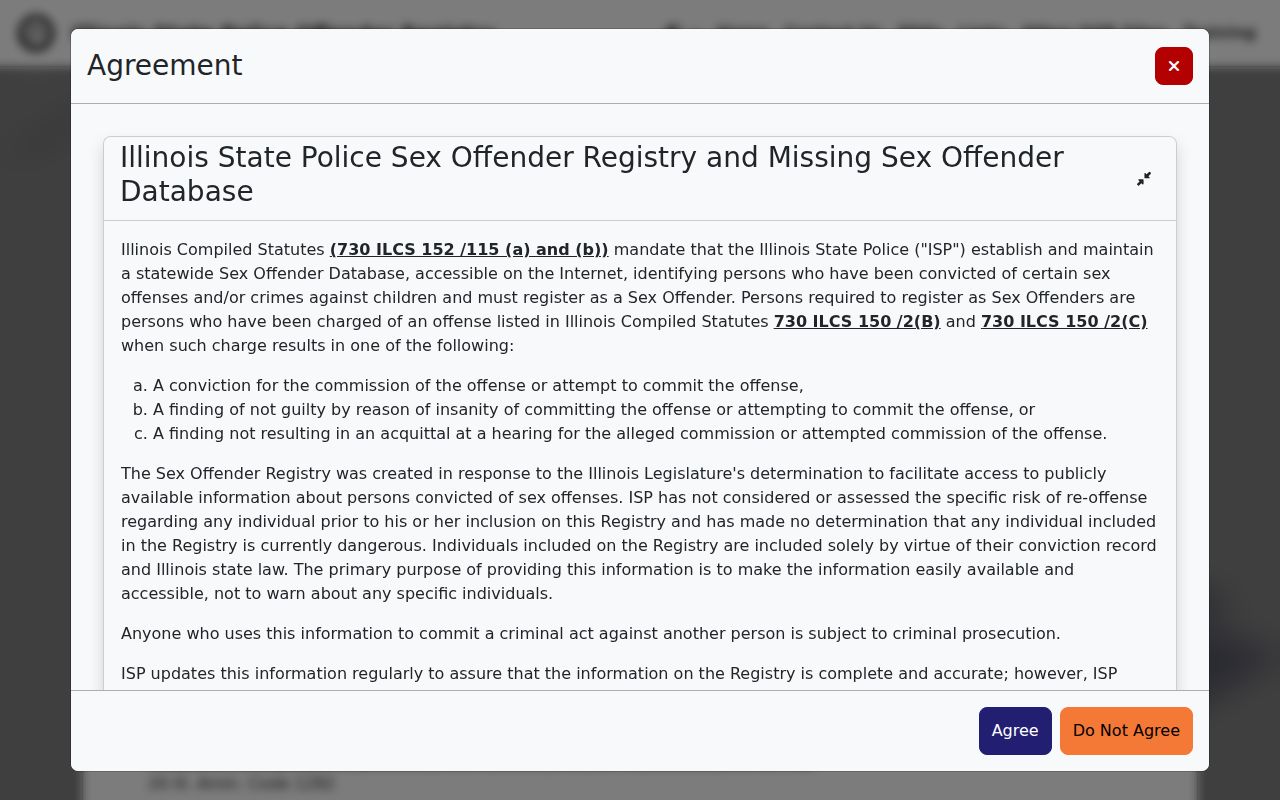
The unit page supplies statutory context, while Fayette County law enforcement handles local facts within its responsibility.
Fayette Searches After Interstate Moves
A Fayette County-only search can miss a person whose record is maintained or whose location is reported in another state. The U.S. Department of Justice National Sex Offender Public Website searches participating jurisdictions through one federal entry point. It is useful after an interstate move or when the correct state is unclear.
The national source below shows the cross-jurisdiction search layer.
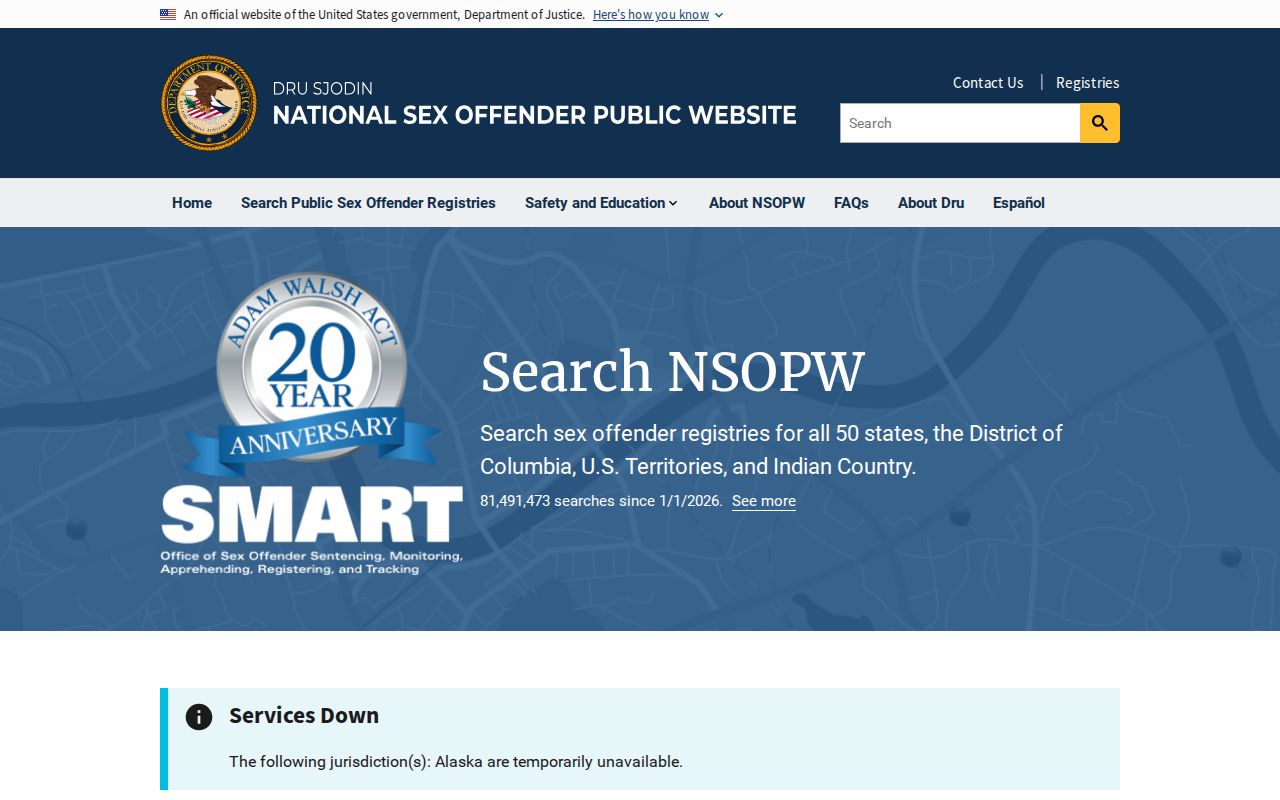
After finding a possible match, verify the details with the originating state registry and responsible registering agency.
NSOPW does not replace the Illinois profile. State registries control their published fields, update paths, and correction contacts. Use the national result to locate the source, then return to that source for details.
Community Notification and Lawful Use
Registry information supports personal, family, and community safety. It can inform a calm safety plan, a talk with family members, or a check of an official public notice. It is not permission to threaten, shame, follow, or confront a registrant or anyone in the household. Accuracy matters because a name, marker, or old address can be misunderstood.
The Sex Offender Community Notification Law, 730 ILCS 152, governs the Illinois public notification system. Report suspected noncompliance to the Fayette County sheriff or the responsible municipal police agency. Give the agency the public profile and the specific fact that appears inconsistent. Let trained officers check it.
Use registry data lawfully: The ISP disclaimer warns that harassment or misuse can lead to criminal or civil consequences. Never threaten, intimidate, or confront a registrant or household.
Public safety works best when reports are precise. Save the date of the search, note the status shown, and identify the agency listed on the profile. That gives law enforcement a clear starting point without escalating risk.